
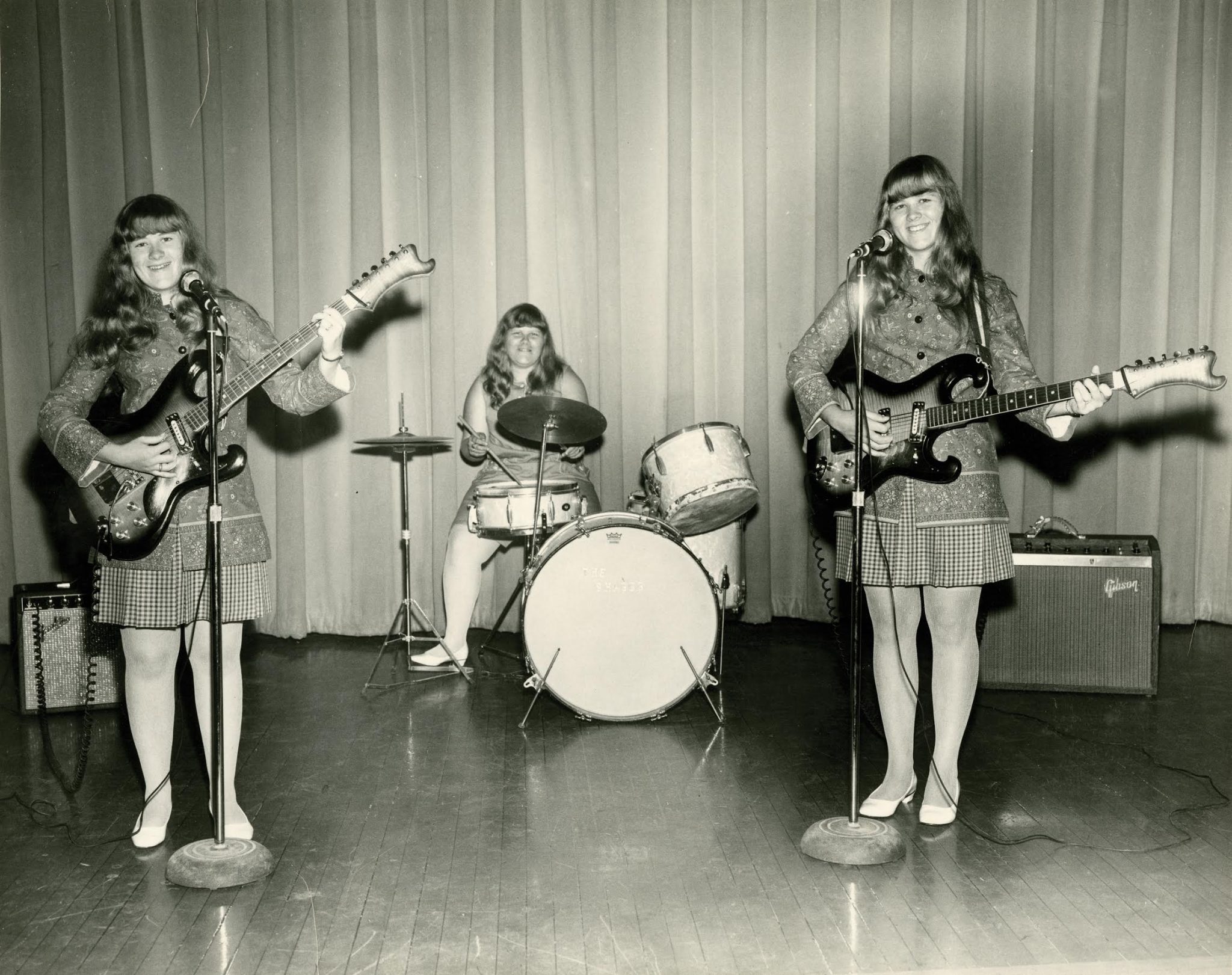
The Shaggs — an all-girl band featuring the three suburban Wiggin sisters from Fremont, New Hampshire — were always an acquired taste. Formed in 1965, they released one album, Philosophy of the World, in 1969, and disbanded in the mid-’70s. Almost all (around 900) of the original 1,000 copies of the album disappeared in mysterious circumstances, but the 100 that escaped to the outside world all found their way to the right people. Frank Zappa was one, playing several tracks from the album during a guest slot on the Dr. Demento radio show as early as 1973, declaring them “Better than The Beatles”. Nirvana frontman Kurt Cobain was also a fan, later declaring that “they were the real thing”.
However, as the intro to Ken Kwapis’s endearing documentary shows, not everybody would agree. Listening to a copy of Philosophy of the World on headphones, his test audiences describe the sounds they are hearing as “caveman stuff”, “almost like something you would hear in your nightmare, over and over”, and “stressful, like being overwhelmed at a busy airport”. Even Kwapis, who came across the album in 1980, way ahead of their subsequent reappraisal, describes their sound as “the most head-scratching music ever committed to vinyl”.
Watch on Deadline
As first glance, Kwapis — director of such films as Dunston Checks In, The Sisterhood of the Traveling Pants and He’s Just Not That into You — might seem out of his usual comfort zone with such an esoteric subject. But The Shaggs’ story, despite its dark edges, is nowhere near as abrasive as their sound (The Shangri-Las go surfing with a chilled Dick Dale); feature films have been mooted for nearly 30 years now, and a stage play opened off-Broadway to acclaim in 2011.
What Kwapis homes in on is the peculiar bond between the three girls who, with the exception of main singer-songwriter and lead guitarist Dot, didn’t really want to be in a band at all. The real driving force behind The Shaggs was their father Austin, whose mother, a palm-reader, predicted when he was young that he would marry a blonde woman and have three daughters who would go on to form a band. “And so of course he lived by that,” notes Dot’s sister Betty (vocals, rhythm guitar). “He made sure that happened.” The prophecy was fulfilled when their sister Helen joined them on — very unpredictable — drums.
The funny thing is, Austin fathered seven children in all, but only Dot, Betty and Helen were coerced into performing, and their father’s monomania is compared, quite alarmingly, to such bullying stage fathers as Murray Wilson (The Beach Boys) and Joe Jackson (The Jackson 5). Though perhaps not as wilfully cruel as the latter, Austin was certainly a hard taskmaster, forcing them to rehearse for hours and lining up shows for local kids at the local town hall (proudly described as “the only tin-sided town hall in New Hampshire”).
We Are the Shaggs, however, is far from a misery memoir or even a hard-luck story; the sisters’ adorable personalities take it from here (“They invented their own musical language, and they adhered to their rules, whatever they were”). But the question remains, and it will likely never be answered, what was everyone thinking? As one commentator notes, they were sheltered for sure but not entirely sequestered — they were classically trained, knew what pop music was, and Dot, in particular was a big fan of Peter Noone and Herman’s Hermits. But The Shaggs didn’t sound like anything like that, as is obvious from a quick spin of their most famous song “My Pal Foot Foot” (“How many time signatures do they go through before they get to the vocals?” wonders a talking head).
The most enlightening section covers the recording of Philosophy of the World, and Kwapis unearths a surprising number of eyewitnesses, given the amount of time that has since passed. An engineer recalls that it was recorded as live, even in a four-track studio, because the girls couldn’t play and sing separately, and also that Austin fostered a belief that their guitars (from Sears) never needed to be tuned. Indeed, when someone stepped in to tune them correctly, the sisters immediately detuned them, saying, “This doesn’t sound like us.” There is a sense, however, that what the music recorded accurately reflects the emotional yin and yang of the two lead sisters — Dot, who wrote songs like “I’m So Happy When You’re Near”, and Betty, who wrote its dark reflection, “Painful Memories”.
Austin died in 1975, without seeing their success (“He would’ve been awful wild,” says Betty. “He would’ve been really excited about it”). Luckily, he also missed the reissue of Philosophy of the World in 1980, which brought with it some of the meanest reviews in the history of music criticism, “The worst record ever made” being one of the kinder things said at the time. But the Wiggin sisters came through the other side and found a much kinder world waiting for them in the ’90s, where audiences were more receptive to their innocence. This charming doc sees them for who they really and were, pushing past the “outsider art” label to arrive at something much more dignified, personal and, ultimately, moving.
Title: We Are The Shaggs
Festival: SXSW (24 Beats Per Second)
Director/Screenwriter: Ken Kwapis
Sales: United Talent Agency
Running time: 1 hr 38 mins
Leave a Reply