
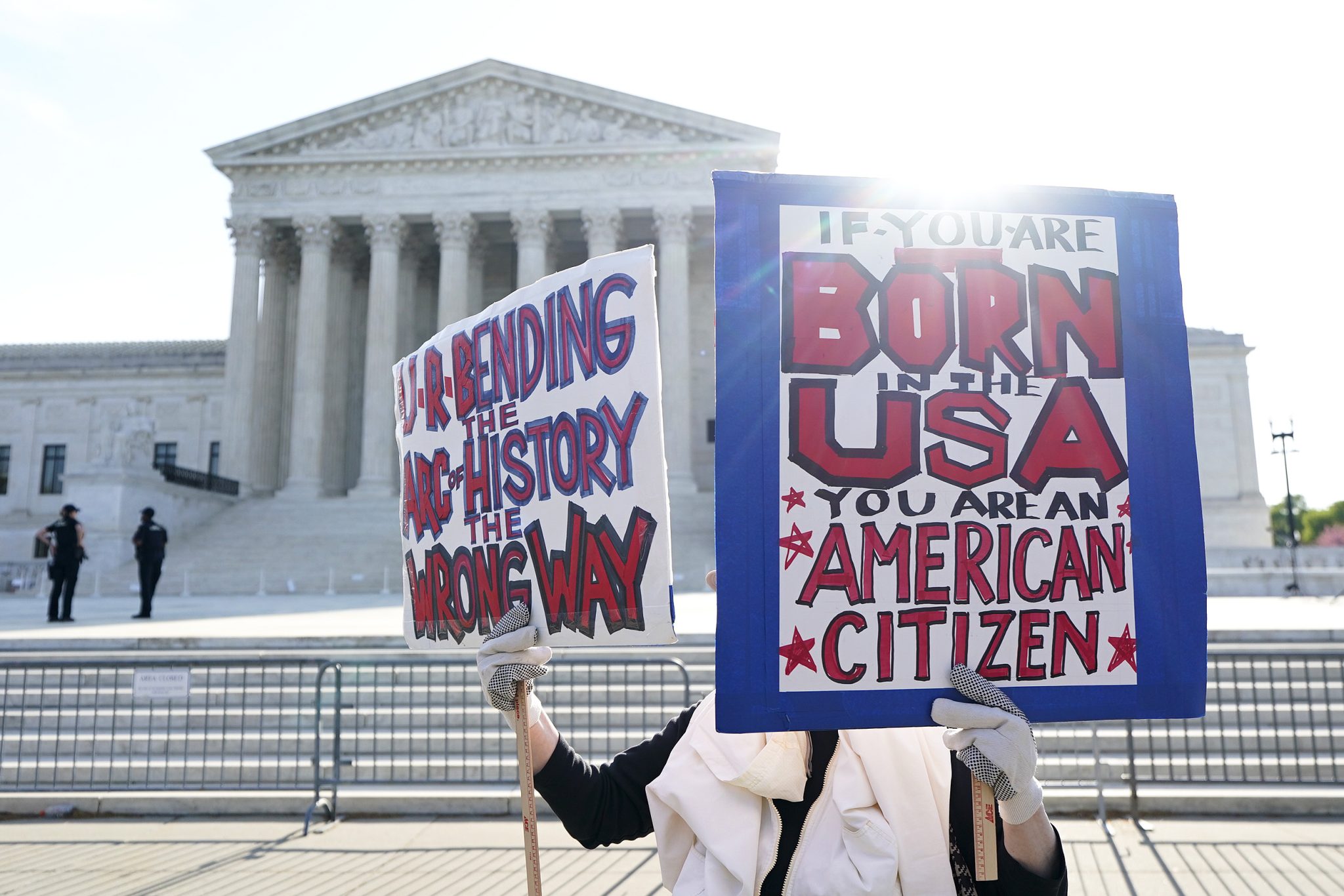
UPDATED: Donald Trump went to the Supreme Court on Wednesday to partake in something none of his predecessors are believed to have done: Attend an oral argument as a sitting president.
The case was his administration’s limits to birthright citizenship via an executive order he issued on the first day in office. If the justices rule for Trump’s side, it will upend the long-held view that almost anyone born in the United States is automatically a citizen.
Through more than two hours of oral arguments, it was difficult to discern which way a majority of the court was leaning.
The president stayed for about 80 minutes, leaving after his solicitor general, John Sauer, wrapped his oral argument and an attorney for the ACLU, challenging the executive order, started hers.
Watch on Deadline
Trump posted on Truth Social afterward, “We are the only Country in the World STUPID enough to allow ‘Birthright’ Citizenship!”
Among those also at the court was Rob Bonta, California’s attorney general, who suggested on MS NOW that Trump’s attendance at the court may have been an effort to try to intimidate the justices. The president has lashed out at the court after a majority, including two he appointed, struck down his authority to impose tariffs.
Trump‘s executive order curbs birthright citizenship of children of undocumented immigrants and of children of those who are in the country on a temporary basis, such as through a student, work or tourist visa. The order was not retroactive, and applied to children born in the future. But the executive order marked a huge departure from the way that the Fourteenth Amendment has been interpreted.
The Fourteenth Amendment states that “all persons born or naturalized in the United States, and subject to the jurisdiction thereof, are citizens of the United States and of the State wherein they reside.” The Trump executive order claims that children of undocumented immigrants and temporary visitors “are not subject to the jurisdiction.” That was a major point of argument on Wednesday, as well as the Immigration and Nationality Act, the 1952 law that contains the same language.
Sauer argued that an 1898 ruling in U.S. vs. Wong Kim Ark, in which the justices ruled that a child born in the U.S. to Chinese parents was a citizen, refers to then having a “permanent residence and domicile.”
Cecillia Wang, attorney for the ACLU, said that the 1898 decision says “six times in the frist parts of the opinion, as well as on the page the government focuses on, that ‘domicile’ is not relevant.”
A number of legal scholars believe that, even with a conservative court, Trump’s chances of prevailing are a long shot. But after the arguments, a number of prognosticators predicted a close vote among the justices.
A federal judge blocked the executive order last year, in a class action suit filed by the ACLU.
The major cable news networks and C-SPAN carried live audio of the arguments. Cameras are not allowed in the Supreme Court chambers.
Leave a Reply